Fly with a new level of confidence.
Instrument Rating
Go beyond fair-weather flying. Build precision and confidence with individual instruction and training tailored to your experience.
- Personalized lessons
- Aircraft and FNL simulator
- Train around your schedule
Build precision, not just experience
- Review your experience
Bring your logbook and plan the hours you need.
- Train with purpose
Aircraft instruction and an FNL simulator option.
- Earn your rating
Prepare for the instrument practical test.
Know what to expect.
Explore the requirements, schedule and training resources.
Can I start?
Most students begin with a private pilot certificate. Bring your logbook so your instructor can review your cross-country pilot-in-command time and prior instrument experience.
What will I learn?
Plan instrument flights, work with air traffic control, and practice departures, holds, approaches, and missed approaches.
A clear path with Sporty’s curriculum
AFI follows Sporty’s curriculum for its core Part 61 pilot training. CFI and CFII courses use Jeppesen curriculum. This gives you a structured path from lesson to lesson while progressing at a pace that fits your experience and proficiency.
How the curriculum works
Your instructor connects your ground preparation with what you practice in the airplane, so you understand each lesson’s goals and what to work on next. Sporty’s training materials help you prepare between lessons and revisit concepts as your skills develop.
Ask Admissions which Sporty’s materials you’ll use for your course and how to get started.
How long will it take?
The usual Part 61 airplane route requires 50 hours of cross-country pilot-in-command time and 40 hours of actual or simulated instrument time, including 15 hours with an instrument instructor. Previously logged qualifying time can count.
Build instrument skills. Make your budget go further.
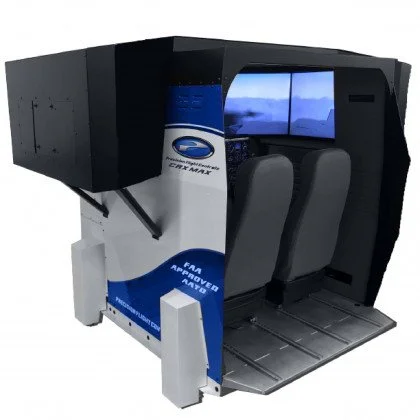
$85 per simulator hour, plus instructor time.
Our PFC CRX MAX advanced aviation training device (AATD) gives you a focused setting to practice instrument scans, holds, approaches, missed approaches, and abnormal situations. Work through a procedure with your instructor, review it, and practice again as you build proficiency.
Simulator sessions can lower your training costs by moving eligible practice out of the airplane. At AFI’s $60 hourly instructor rate, one simulator hour with one hour of instruction totals $145. Additional briefing or ground instruction is billed for the time used.
Your instructor will plan a mix of simulator and aircraft lessons and confirm which simulator time counts toward your rating under the device’s FAA authorization.
More about PilotEdge, IPCs and simulator training
Build radio confidence with PilotEdge.
We use PilotEdge to enhance ATC communication practice in our simulator. You’ll tune the radio and speak with live controllers through your headset, practicing clearances, readbacks, frequency changes, and approach instructions while managing the flight.
These realistic exchanges help you develop clear communication and manage cockpit workload alongside your instrument skills.
See how PilotEdge communications work ↗
Already rated? Keep your instrument skills sharp.
Use the simulator for an instrument refresher, IPC preparation, and approved portions of an Instrument Proficiency Check (IPC) with an instrument instructor. Your instructor will review the device’s authorization and arrange the aircraft portion needed to complete the check, including circling and landing tasks.
Connect with AdmissionsWhat should I budget?
View campus hourly rates
| Campus | Cessna 172, wet | Instructor | Aircraft + instructor |
|---|---|---|---|
| Fort Collins / Loveland (FNL) | $195 | $60 | $255 |
| Cheyenne (CYS) | $185 | $60 | $245 |
The wet aircraft rate includes fuel. The combined figure assumes one hour each of aircraft and instructor time.
Our calculator estimates $10,150 in Loveland (including 20 qualifying simulator hours) or $11,650 in Cheyenne, including instruction, a checkride allowance and ground course. Actual costs depend on prior experience and training needs.
Where can I train?
Part 61 training is offered in Fort Collins / Loveland and Cheyenne. Cheyenne also offers structured Part 141 training. Course requirements depend on the approved syllabus.
What will I fly?
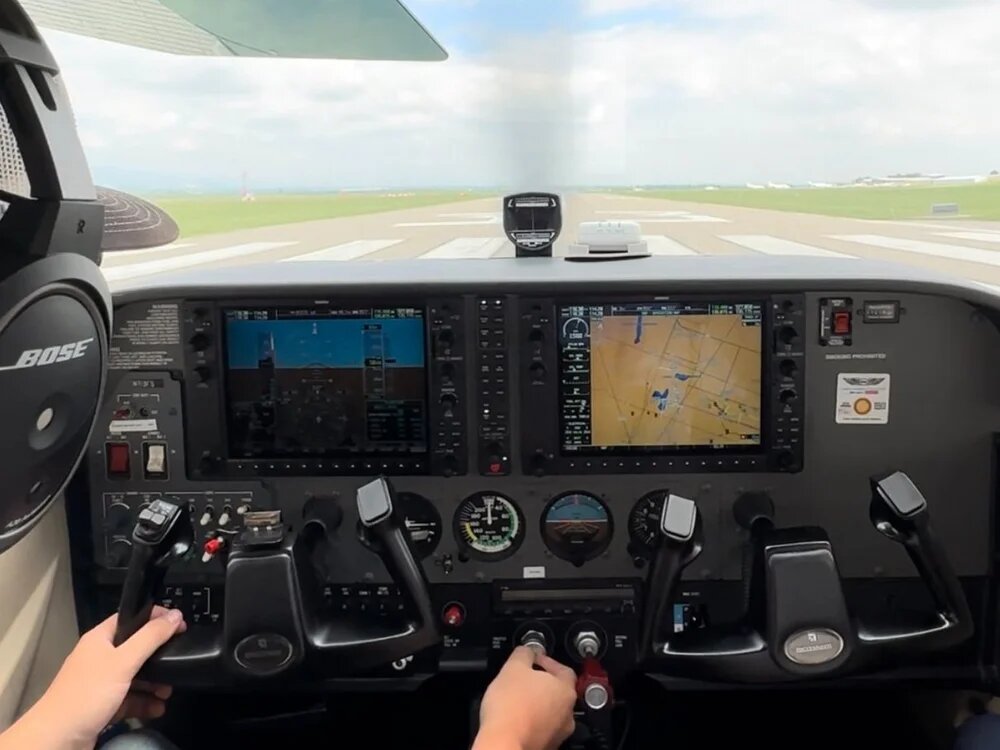
Our training fleet consists of Cessna 172s. One has a Garmin G1000 glass cockpit. Other aircraft have Garmin G5 displays or traditional round-dial instruments (steam gauges).
Explore our fleet